EN
Translate:
EN

Translate:
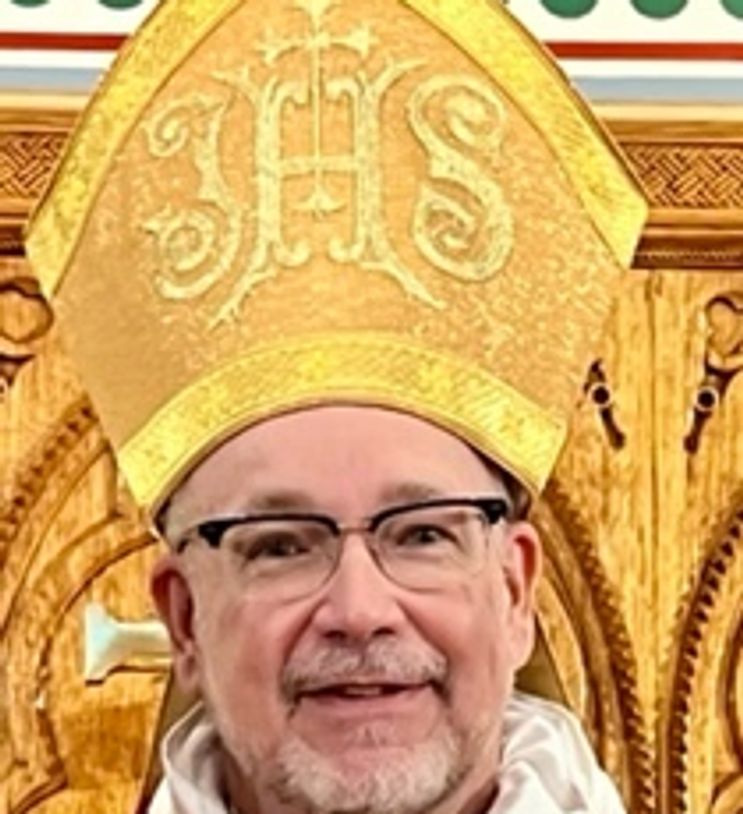
His Episcopal motto "Dominus illuminatio mea" (The Lord is my light) is taken from the opening words of Psalm 27 and is the used by the University of Oxford as its motto. It reminds us that only in Christ do we have the light of salvation. In the light of Christ, we shall not be afraid of anything.
The Right Reverend William Bower, SSC was elected to be the bishop suffragan of the Diocese of the West of the Anglican Church in America at its Synod in September 2020 and was consecrated on July 10, 2021. He was born in Atlanta, Georgia in 1964, where he attended grade school through high school. It was during this period that he was a member of the Grammy A ward winning Atlanta Boy Choir and was part of a student exchange program with the Vienna Boys Choir. In his teen years he relocated with his family to the Los Angeles area where he finished high school and met the love of his life, Sabrina Thai, whom he married in 1984.
He attended the University of California at Los Angeles (UCLA) on an Army scholarship and received a Reserve commission in 1985. In 1986 he founded Contemporary Information Corporation, a data company, in Santa Clarita, California. As a bi-vocational clergyman, he continues to work full time at his secular employment as well as being engaged in pastoral ministry.
After being ordained both deacon and priest in a noncanonical old calendar Orthodox jurisdiction, Bishop Bower moved his congregation into the Orthodox Church in America. In 1997 he completed the Late Vocations Program and was ordained a deacon by Bishop Tikhon (Fitzgerald). He attended St. Tikhon's Orthodox Theological Seminary from 1997 - 2000. He was incardinated in the Anglican Church in America in July of 2000 and assigned to St. Mary of the Angels parish in Hollywood, California, where he participated in the St. Mary's Theological College. In 2002 he was ordained to the priesthood by Bishop James Gordon Stewart. In 2001 Bishop Bower began a degree by research program with the University of Oxford, and in 2013 was awarded the degree of Master of Philosophy specializing in Theology.
Bishop Bower was the founding rector of the parish of St. Columba in Lancaster, California which he served from 2002-2013. From 2014 until 2019 he assisted at two Anglican parishes in Atlanta, Georgia. In July 2019 he began filling in at St. Mary of the Angels parish and was assigned as Locum Tenens in August of that year. He has faithfully served St. Mary of the Angels for two years providing pastoral leadership to guide the parish through a crisis period into stability including finding and training a permanent parish priest.
He has served as Canon to the Ordinary for three diocesan bishops, has been a member of almost every diocesan committee, and is a long-term member of the Societas Sanctae Crucis (Society of the Holy Cross).
Bishop Bower and his wife Sabrina have four adult children, Rebecca, Ian, Catherine, and Julia. When not engaged by secular or church work, they enjoy spending time boating in coastal South Carolina or on the Suwannee River in Florida.
EMAIL: william.bower@theology.oxon.
PHONE: 706-530-0690

Each year, Christians eagerly await Easter, the celebration of the Resurrection of our Lord. This sacred event marks the culmination of the Lenten journey and completes the Sacred Triduum. Easter signifies our transition from darkness to light, from sorrow to joy, and from the reality of sin to the boundless happiness found only in forgiveness through Christ Jesus.
However, not all Christians hold the same view on Easter. Recently, I received a postcard inviting people to an “Easter Celebration” at a local Christian church. The front of the postcard featured graphics, Easter eggs,
confetti, a QR code, the church’s name, and details about two Easter services.
On the reverse side of the card, there was a lot of text. It required careful reading to find the phrase “celebrating the resurrection of Jesus Christ” among descriptions of a “casual atmosphere,” a statement that “We are a
contemporary Christian church,” and explanations about the two Easter egg hunts—one for each service. Most notably, there was an announcement of a prize drawing for a “kid’s electric car & bike,” including photos of the prizes and instructions for in-person registration.
While I pray that these efforts draw people into a sincere faith in Christ rather than merely into fun and prizes, I am concerned that the faith they develop may be superficial. This raises an important question: What does
Easter truly represent?
First and foremost, Easter is the Christian Passover. Jesus is the Paschal Lamb who passed from death to life—not symbolically, but actually and physically. This supreme miracle is the paramount cosmic victory over
both sin and death.
“And if Christ be not risen, then is our preaching vain, and your faith is also vain.” (1 Corinthians 15:14)
The Resurrection of Christ is closely connected to His crucifixion on Good Friday. Jesus' death provides forgiveness for our sins, and crucifixes in churches serve as reminders of this moment of salvation. This is
known as the “Paschal Mystery”, encompassing Christ’s crucifixion, His three days in the tomb, and His resurrection. These events fulfilled the Old Testament prophecies and gave us forgiveness, hope, and the
certainty that we, too, will be raised from the dead.
“But we preach Christ crucified, unto the Jews a stumbling block, and unto the Greeks foolishness; But unto them which are called, both Jews and Greeks, Christ the power of God, and the wisdom of God.” (1 Corinthians 1:23-24)
The dogma of the undivided Christian Church teaches that we will be resurrected from the dead, as proclaimed in the Nicene Creed: “
I look for the resurrection of the dead and the life of the world to come.”
We are assured that we will be raised at the time of the final renewal of creation. This is not merely an escape from worldly troubles or an ascent to heaven in the clouds. It is the ultimate realization of God’s Kingdom,
where sin and death are destroyed, and we enjoy the ultimate relationship with the Holy Trinity through perfect love.
Easter celebrates both the resurrection of our Lord Jesus Christ and the anticipation of our own resurrection into the “life of the world to come.” We achieve complete communion with God through the Blessed Sacrament of the Altar, which strengthens us throughout our lives. By receiving the Body and Blood of Jesus, we become living tabernacles of grace that extend into the world.
Certainly, those whose understanding of Easter is focused on casual fun and raffle prizes might find our celebration quite intense. Indeed, our observance of the three days exceeds what our society can grasp. To them, it is just another time for family, food, and fun. But for us, it is a moment of immense joy because our Saviour lives and grants us ongoing hope in our own resurrection to live with Him.
Because of Easter, we acknowledge that our lives have significance and purpose. The total of our existence is not a slow journey to the grave in a hearse. Instead, the purpose of our being is revealed in the risen Christ, who dwells in us, and we in Him. We no longer must face the trials and struggles of this world alone because He is with us. And we no longer must fear death because He has conquered death and promised us eternal life with Him. Now that is truly a meaningful celebration – no prizes necessary!
Christ is risen! Alleluia! Alleluia!
He is risen indeed! Alleluia! Alleluia!